Wednesday, July 22, 2009

Thursday, June 11, 2009
Sunday, January 25, 2009
Grave warning

Grave warning
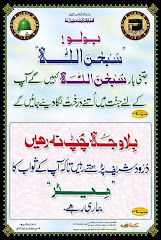
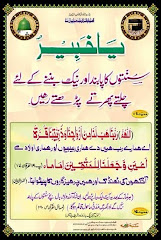
Hadith 1 : Sayyiduna ibn Abbas (radi Allahu anhuma) narrates that Sayyiduna Rasoolullah (sallal laahu alaihi wasallam) said, "He who forgets to read the Durood Shareef, has certainly forgotten the path to Jannah". (Al Qolul Badi)
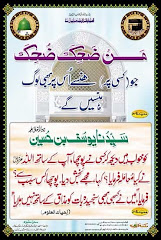
Hadith 2 : Nabi Muhammad (sallal laahu alaihi wasallam) said, "On the Day of Qiyamah there will be people who will be ordered to enter Jannah, but will not find the path to Jannah". When the Sahaba asked as to what the reason for this would be, he replied, "There will be individuals who did not read the Durood Shareef when they heard my name being mentioned". (Nuzhatul Majaalis)
Hadith 3 : Sayyiduna Abu Hurairah (radi Allahu anhu) narrates that Sayyiduna Rasoolullah (sallal laahu alaihi wasallam) said, "He who has forgotten to read the Durood Shareef, has truly forgotten the path to Jannah". (Al Qolul Badi)
Hadith 4 : Sayyiduna Rasoolullah (sallal laahu alaihi wasallam) said, "Certainly that person is a miser who does not read the Durood Shareef when my name is mentioned in front of him". (Mishkaat)
Hadith 5 : Sayyidah Ayesha Siddiqa (radi Allahu anha) narrates that Sayyiduna Rasoolullah (sallal laahu alaihi wasallam) said, "There will be three individuals who will be deprived of recognizing me. The first is he who does not obey his parents. The second is he who abandons my Sunnah. The third is he who does not read the Durood Shareef when my name is mentioned". (Al Qolul Badi)
Hadith 6 : Sayyiduna Jaabir (radi Allahu anhu) narrates that Sayyiduna Rasoolullah (sallal laahu alaihi wasallam) said, "When a group of people gather and then arise without having mentioned Almighty Allah and not having recited the Durood Shareef, then it is as if they have arisen after consuming rotten flesh". (Al Qolul Badi)
Hadith 7 : Sayyiduna Abu Sa'eed Khudri (radi Allahu anhu) narrates that Sayyiduna Rasoolullah (sallal laahu alaihi wasallam) said, "When people sit in any gathering without reading the Durood Shareef, even though some will enter Jannah, they will be full of regrets". (Regret when looking at the lofty position achieved by others who were in the habit of reading the Durood Shareef) (Al Qolul Badi)
Hadith 8 : Sayyiduna Abu Hurairah (radi Allahu anhu) narrates that Sayyiduna Rasoolullah (sallal laahu alaihi wasallam) said, "Those individuals who sit in any gathering without having remembered Almighty Allah or read the Durood Shareef, they will experience hardship on the Day of Qiyamah. Thereafter, it will be the Divine Wish of Almighty Allah whether or not He allocates to them punishment or reward". (Al Qolul Badi)
Hadith 9 : Sayyiduna Anas (radi Allahu anhu) narrates that Sayyiduna Rasoolullah (sallal laahu alaihi wasallam) said, "May I show you who among the misers is the greatest of misers? It is he who does not read the Durood Shareef when in front of whom my name is mentioned". (Al Qolul Badi)
Hadith 10 : Sayyiduna Jarraad (radi Allahu anhu) narrates that Sayyiduna Rasoolullah (sallal laahu alaihi wasallam) said, "When I am remembered in front of any individual, and the individual does not read the Durood Shareef, he will certainly enter Hell". (Al Qolul Badi)
Hadith 11 : Sayyiduna Rasoolullah (sallal laahu alaihi wasallam) said, "It is an injustice that when I am mentioned in front of an individual, he does not read the Durood Shareef". (Al Qolul Badi)
Hadith 12 : Sayyiduna Jaabir (radi Allahu anhu) narrates that Sayyiduna Rasoolullah (sallal laahu alaihi wasallam) ascended the Mimbar. When he had climbed the first step he said, "Aameen". He also said "Aameen" each time he climbed the second and third steps. When the Sahaba asked him about this, he replied, "When I had climbed the first step, Sayyiduna Jibra'el Ameen presented himself and said, 'Unfortunate is that person who finds the Month of Ramadaan and let it pass by without being forgiven'. To this, I replied, Aameen. "On the second step Sayyiduna Jibra'el said, 'Unfortunate indeed is that person who in his lifetime has his parents or at least one of them, yet (by being of service to them), he did not achieve Jannah'. To this, I replied, Aameen. "On the third step Sayyiduna Jibra'el said, 'Unfortunate indeed also is that person in front of whom you are mentioned (O Muhammad) sallal laahu alaihi wasallam, yet he does not read the Durood Shareef'. I again replied, Aameen". (Bukhari Shareef)
Hadith 13 : Sayyidah Ayesha Siddiqa (radi Allahu anha) narrates that during the last few moments of the Sehri she had lost the light of the candle and also the needle that she was sewing with. Suddenly, Sayyiduna Rasoolullah (sallal laahu alaihi wasallam) arrived. Due to the brilliant light (Noor) from his face, she found the lost needle. When she commented about how brilliant the features of Sayyiduna Rasoolullah (sallal laahu alaihi wasallam) was, he replied, "Destruction is for that person who would not be able to see my face on the day of Qiyamah". When asked as to who that person would be, he replied. "That person who is a miser, and the miser is he who does not read the Durood Shareef when hearing my name". (Nuzhatun Naazireen)
Hadith 14 : It is recorded that a hunter captured a buck and was passing by Sayyiduna Rasoolullah (sallal laahu alaihi wasallam). Almighty Allah gave the buck the power of speech. Addressing Sayyiduna Rasoolullah (sallal laahu alaihi wasallam), the buck pleaded, "O Prophet of Allah! I have little ones who are in need of milk. At this moment they are very hungry. Please command the hunter to release me so that I can feed them and then return". Sayyiduna Rasoolullah (sallal laahu alaihi wasallam) asked her what would happen if she did not return. She replied, "If I do not return then the Curse of Almighty Allah will be upon me as the Curse of Almighty Allah is upon that person who does not read the Durood Shareef when you are mentioned. The curse of Almighty Allah is also upon that person who performs the Salaah but does not read the Du'a after it". Sayyiduna Rasoolullah (sallal laahu alaihi wasallam) then ordered the hunter to release the buck as she would return as promised after feeding her young. A few minutes later the buck did return. At that moment Sayyiduna Jibra'el Ameen presented himself to Sayyiduna Rasoolullah (sallal laahu alaihi wasallam) and declared, "O Prophet of Allah! Almighty Allah sends His Salaams to you and has declared, 'By My Respect and Magnificence! I am certainly more merciful upon your followers (O Muhammad) than this buck upon its young. I would also return your followers to you as this buck has return to you'". (Al Qolul Badi)
Hadith 15 : Nabi Muhammad (sallal laahu alaihi wasallam) said, "All those deeds which do not begin with the remembrance of Almighty Allah and the recital of the Durood Shareef are deeds without blessing and divorced from all good". (Mutaali'ul Musarraat) The same Hadith as mentioned above also refers to speeches and lectures. (Mutaali'ul Musarraat)

Wonders of Allah in Seeds of Coconut Palm

Wonders of Allah in Seeds of Coconut Palm
The seeds of some plants are dispersed by water. These seeds typically have characteristics different from the seeds of other plants. For example, plants which disperse their seeds by water possess a structure that minimizes their weight and maximizes their surface area. In addition, the floating tissue might take any of several shapes. The cells filled with air might have a spongy structure or the air might be locked in the seed in such a way that gaps among the cells are almost lost, enabling the seed to float. In addition, the cell walls of the floating tissue are structured in such a way as to prevent water from entering. Besides all this, there is an additional interior segment in these plants which protects the embryo that contains all the genetic information about the plant.
Among those seeds carried by water, there are seeds that can remain in the water for about 80 days without being spoiled or germinating owing to their strong structure. The most famous of these are the seeds of the coconut palm tree. The seed of the palm is put into a hard shell for safe transport. In this hard shell, everything that is needed for a long journey, including water, is available. Also, the outer part is covered with a strong fabric that prevents the seed from being damaged by water.
One of the most significant features of a coconut seed is that it has air spaces that make it buoyant and capable of floating on water. Because of these characteristics, the coconut seed can be carried by ocean currents for thousands of kilometers. When it washes ashore, the seed germinates and grows into a coconut palm tree.
It is quite an exceptional situation that the coconut seeds germinate just as they reach the land because, as is known, plant seeds generally germinate as soon as they meet water. Yet, this is not true for coconut plants. With their distinctive structures, plants which disperse their seeds by water are privileged in this respect. If these plants, too, began to germinate as soon as they encountered water, they would have long ago since become extinct. However, by means of their mechanisms suitable to their particular environments, these plants can continue to exist. It is evident that these precise features and design could not have come into being by the methods evolutionists claim.
The amount of reserved nutrition and water in the seeds, the period of their reaching the land, in short all the delicate calculations made for such features have been perfectly determined by Allah, Who is the owner of eternal power and wisdom.
Wonders of Allah in Dazzling Pearls

Wonders of Allah in Dazzling Pearls
On Earth, wherever one turns his eyes and looks, one meets a magnificent creation, a perfect design with amazing features. The examples we give throughout this book are only a few small details of this magnificence. Allah has created many plant and animal species on Earth whose appearances are splendid. He has brought everything into existence in a way that man finds pleasure in. Along with these, many ornaments have been created on Earth by Allah and have been given into the service of men. The pearl, which is one of these ornaments, has very interesting features besides its outstanding beauty.
The developmental phases of the pearl are amazing. The pearl is generally produced by the "pearl oyster," of which many kinds exist. The shells of oysters are quite hard. The composition of their outer shells, which are very difficult to open, is calcium carbonate-based and deters many of their enemies. The calcium carbonate also plays an important role in the oyster's formation of pearls.
The oyster is irritated when sand, a pebble or harmful parasitic organisms enter inside of it. In such situations, it isolates the uninvited guest, as a method of protection, and begins to cover it with nacre. This covering process is the first phase of the formation of the pearl. The foreign particles entering the oyster serve as a nucleus for the formation of the pearls. Through the years, the surface of this nuclear substance will be covered with calcium carbonate layers forming one on the top of the other.
How is the nacre inside the oyster made? There are two main ingredients that form the nacre among the layers of the oyster's inner tissues. In one layer is a mineral called "aragonite," the content of which is calcium carbonate; in another layer is an adhesive substance "conchiolin," which holds the aragonite together in the pearl. Since aragonite is a semi-transparent substance, it gives the pearl a shiny look. It is surely thought provoking that these two substances are produced by the oyster (a composition of shell and flesh that doesn't even have a brain) and then they come together and form such a beautiful object as a pearl by covering a mere dust particle. The pearl that an oyster produces for the purpose of protection is created as an aesthetic ornament for man.
Allah draws attention to the pearl with the verse in the Qur'an "From out of them come glistening pearls and coral." (Surat ar-Rahman: 22) Furthermore, the pearl is also mentioned in the Qur'an as one of the ornaments of Paradise.
Wonders of Allah in Water Lilies

Wonders of Allah in Water Lilies
Little flowers on the earth are mostly considered commonplace by people, notwithstanding their overall perfection. What prevents people from grasping the creation miracles in these flowers is the familiarity brought about by seeing them everywhere and every day. Therefore, flowers that grow in a totally different place, under totally different conditions and in totally different sizes will be assessed without the "glasses of familiarity" and thus help us grasp the existence of God.
Amazon water lilies that grow in the sticky mud covering the bottom of the Amazon River are interesting enough to remove the 'glasses of familiarity' from people, because they continue their lives not in the way people are accustomed to and witness everyday, but with a very different struggle.
These plants start to grow in the mud at the bottom of the Amazon River, and then reach out towards the river surface. Their goal is to reach the sunlight which is vital to their existence. When they finally reach the water's surface, they stop growing and develop thorny, round buds. The buds develop into gigantic leaves with a reach of 2 metres, in as short a time as a couple of hours. "Knowing" that the more they cover the river surface with abundant leaves, the more will they be able to make use of sunlight, these water lilies make ample use of daylight to perform photosynthesis. They "know" that otherwise they will not be able to survive at the bottom of the river due to the scarcity of light. It is certainly quite inspiring for a plant to employ such an "intelligent" tactic.
However, sunlight alone does not suffice for the Amazon water lilies. They also need oxygen equally, yet it is obvious that this oxygen does not exist in the muddy ground in which their roots are located. This is why water lilies stretch out stems developing from their roots upwards towards the water surface where their leaves float. Sometimes these stems grow as tall as 11 metres; they are tied to the leaves and function as oxygen-carriers between the leaves and the root.
How can a bud in its initial stages of life in the depths of a river know that it needs oxygen and sunlight to survive, that it would not be able to live in their absence, and that everything it needs is present on the water surface? A being recently introduced to life is aware neither of the fact that this water has an ending point, nor of the existence of the sun or oxygen.
Therefore, if the whole event is assessed from the standpoint of evolutionists, these plants should long before have been defeated by environmental conditions and become extinct. Nevertheless, water lilies are still present today in all their perfection.
The unbelievable life struggle of water lilies continues well after they reach light and oxygen on the water surface, where they curl the brims of their huge leaves upward to prevent them from sinking.
They can continue their lives with all these precautions, yet they also know that these are not enough for their reproduction. They need a living being that will carry their pollen to another water lily, and this living being is a beetle (coleopteran) which has been created with a special weakness for white colour. They prefer these white water lilies out of all the attractive flowers of the Amazon River. When Amazon water lilies are visited by creatures which will continue their species, they close all their leaves, imprison them, and offer them ample pollen. They let them free after keeping them for one night, and then change their colour so that they do not bring the same pollen back to them. The once pure white, glorious water lilies will now go on adorning the Amazon river in pink.
Could such flawless and finely calculated plans be the work of a bud unaware of everything? Of course not. They are the work of the wisdom of God, Who created all things. All the details summarized here show that plants, like all other living beings in the universe, came into existence already furnished with the most convenient systems, and this was thanks to their Creator.
Wonders of Allah in Social System of Ants

Wonders of Allah in Social System of Ants
Ants live in colonies and a perfect division of labor exists amongst them. When we take a closer look at their systems, we shall also see that they have a pretty interesting social structure. It will also come to our attention that they are capable of sacrifice at a much higher level than humans are. One of the most interesting points is that - compared to humans - they do not know the concepts such as the rich-poor discrimination and the fight for power that are observed in our societies.
Many scientists, who for years have been doing extensive research on ants, have not been able to clarify the subject of their advanced social behavior. Caryle P. Haskins, Ph.D., the president of the Carnegie Institute at Washington has this to say:
After 60 years of observation and study, I still marvel at how sophisticated the ants' social behavior is. …The ants thus make a beautiful model for our use in studying the roots of animal behavior. (National Geographic, vol.165, no.6, p. 775)
Some colonies of ants are so extensive with respect to population and living area, that it is impossible to explain how they can form a perfect order over such a vast area. Therefore, it is not easy not to concur with Dr. Haskins.
As an example of these large colonies we can give the species of ant, called Formica Yessensis that lives on the Ishikari coast of Hokkaido. This ant colony lives in 45,000 interconnected nests over an area of 2.7 square kilometers. The colony, which is composed of approximately 1,080,000 queens and 306,000,000 workers, has been named the "Super colony" by the researchers. (Bert Hölldobler-Edward O.Wilson, The Ants, Harvard University Press, 1990, p. 1.) It has been discovered that all production tools and food are exchanged in an orderly fashion within the colony.
It is very hard to explain how the ants have maintained this order without any problems, considering the vast area they are living in. We must not forget that various security forces are needed for enforcing law and maintaining social order, even in a civilized country with a low population density. And there is an administrative staff leading and managing these units. Sometimes, it does not become possible to maintain the required order without problems despite all these intense efforts.
Yet in ant colonies there is no need felt for police, gendarmerie or guards. If we consider that actually the duty of the queens, whom we think of as the leaders of the colonies, is just to maintain the species, they do not have a leader or a governor. There is thus no hierarchy based on a chain of command amongst them. Then who is it that lays down this order and maintains its continuity?
The fact that ants can establish such a great and perfect order is proof that they are acting on the inspiration of a certain "supervisor". The verse below fully confirms that God is the master and supervisor of everything and that every living creature acts on His inspiration:
I have put my trust in God, my Lord and your Lord. There is no living being He does not hold by the forelock and inspect! My Lord is on a straight path. (Surah Hud: 56)
Wonders of Allah in Butterflies

Wonders of Allah in Butterflies
Look over the butterflies' wings in the picture on the left as if you were seeing them for the first time. Surely you will be filled with admiration for such an aesthetic display, a symmetry that is without the slightest flaw, the dazzling colors and patterns. Now think of a piece of cloth. Assume that it is a very beautiful piece of cloth of good quality that has been woven with the inspiration of these butterflies' patterns. What would you think if you saw such a piece of cloth in a shop-window? Probably, the existence of an artist, who has drawn the patterns of this cloth, taking the wings of a butterfly as an inspiration while drawing them, springs into your mind, and you appreciate his artistry. In this situation, you should also appreciate this fact: the artistry you admire doesn't belong to the person who draws the cloth pattern, taking butterflies as his example, but to Allah, Who is the originator of the patterns and colors of butterfly wings. The colorful wings of butterflies with their wonderfully varied patterns are magnificent manifestations of Allah's artistry in color. Just as a pattern on a piece of cloth does not come into being by chance, so is the color and pattern symmetry in the wings so perfect that they could not have come into being coincidentally.
Moreover, the splendid wings are not the only striking features of butterflies. The body design of butterflies is also perfect in every respect. The butterflies take in nourishment by sucking up nectar from flowers. Most butterflies have a long organ called a proboscis which they use to reach a liquid that is at some depth. A proboscis is a long tongue used to drink water or to suck up nectar from flowers. The butterfly rolls up its long tongue inwards when it isn't using it. This tongue can be three times the length of a butterfly's body when unrolled.
Like other insects, the butterflies also have a skeleton that covers the outer surface of their bodies. This outer or exoskeleton is composed of hard plates connected by soft tissue, looking like some sort of armor. The hard material is called "chitin." The formation of this layer comes about through a very interesting process. As is commonly known, caterpillars pass through a rather complex process called metamorphosis. The caterpillar first becomes a pupa and then turns into a butterfly. Throughout this process of metamorphosis, slight changes occur in the wings, antennae, legs and other body parts. Also, the cells in different key areas such as the flight muscles and wings re-organize themselves through every phase of metamorphosis. Furthermore, along with these changes, almost all systems in the body -the digestive system, excretory system, respiratory system etc.- go through a process of immense change.
This diversity in design that butterflies have, as much as their wings, belongs to Allah, the All-Powerful. Allah is the One Who bestows every creature with the characteristics it needs.
Saturday, January 24, 2009
Human Rights in Islam

Human Rights in Islam
Since Allah is the Absolute and the Sole Master of men and the universe, He is the Sovereign Lord, the Sustainer and Nourisher, the Merciful, Whose mercy enshrines all beings; and since He has given each man human dignity and honor, it follows that, united in Him and through Him, and apart from their other human attributes, men are substantially the same and no tangible and actual distinction can be made among them, on account of their accidental differences such as nationality, color or race. Every human being is thereby related to all others and all become one community of brotherhood in their honorable and pleasant servitude to the most compassionate Lord of the Universe. In such a heavenly atmosphere the Islamic confession of the oneness of God stands dominant and central, and necessarily entails the concept of the oneness of humanity and the brotherhood of mankind.
Although an Islamic state may be set up in any part of the earth, Islam does not seek to restrict human rights or privileges to the geographical limits of its own state. Islam has laid down some universal fundamental rights for humanity as a whole, which are to be observed and respected under all circumstances whether such a person is resident within the territory of the Islamic state or outside it, whether he is at peace or at war. The Holy Quran from the English translation of the "Kanzul Iman" very clearly states:
"O believers, stand up firmly by the Commandments of Allah, bearing witness
with justice and let not the enmity of any people incite you that you should
not do justice. Do justice that is nearer to piety and fear Allah,
undoubtedly, Allah is aware of your doings." (5:8)
Human blood is sacred in any case and cannot be spilled without justification. And if anyone violates this sanctity of human blood by killing a soul without justification, the Holy Quran from the English translation of the "Kanzul Iman" equates it to the killing of entire mankind.
"...whosoever killed a soul not to retaliate for a soul, nor for creating
disorder in the land, then it is as if he had killed all mankind. And whoso
gave life to one soul, then it is as if he had given life to all
mankind..."(5:32)
It is not permissible to oppress women, children, old people, the sick or the wounded. Women's honor and chastity are to be respected under all circumstances. The hungry person must be fed, the naked clothed and the wounded or diseased treated medically irrespective of whether they belong to the Islamic community or are from among its enemies.
When we speak of human rights in Islam we really mean that these rights have been granted by God; they have not been granted by any king or by any legislative assembly. The rights granted by the kings or the legislative assemblies, can also be withdrawn in the same manner in which they are conferred. The same is the case with the rights accepted and recognized by the dictators. They can confer them when they please and withdraw them when they wish; and they can openly violate them when they like. But since in Islam human rights have been conferred by God, no legislative assembly in the world or any government on earth has the right or authority to make any amendment or change in the rights conferred by God. No one has the right to abrogate them or withdraw them. Nor are they basic human rights which are
conferred on paper for the sake of show and exhibition and denied in actual life when the show is over. Nor are they like philosophical concepts which have no sanctions behind them.
The charter and the proclamations and the resolutions of the United Nations cannot be compared with the rights sanctioned by God; because the former are not applicable on anybody while the latter are applicable on every believer. They are a part and parcel of the Islamic Faith. Every Muslim or administrator who claims himself to be Muslim, will have to accept, recognize and enforce them. If they fail to enforce them, and start denying the rights that have been guaranteed by God or make amendments and changes in them, or practically violate them while paying lip service to them, the verdict of the Holy Quran from the English translation of the "Kanzul Iman" for such government is clear and unequivocal:
"Undoubtedly, We have sent down Taurah, wherein is the guidance and light.
According to it the Jews were ordered by Our obedient prophets and men of
learning and jurists for it was desired from them to preserve the Book of
Allah and they were witnesses to it, then fear not people, but fear Me and
do not accept mean price for Our Signs. And whoso judges not according to
what Allah has sent down, they are the persons who are infidels."(5:44)
Human Rights In An Islamic State
The Security Of Life And Property:
In the address which the Holy Prophet (Peace be upon HIM) delivered on the occasion of the Farewell Hajj, he said:
"Your lives and properties are forbidden to one another till you meet your
Lord on the Day of Resurrection." The Prophet (Peace be upon HIM) has also
said about the dhimmis (the non-Muslim citizens of the Muslim state): "One
who kills a man under covenant (i.e., dhimmi) will not even smell the
fragrance of Paradise."
The Protection Of Honor:
The Holy Quran from the English translation of the "Kanzul Iman" lays down:
"O believers! let not the men scoff at the men, perchance they may be better
than those who scoff, and nor the women at other women, perchance that
they may be better than those women who scoff, and do not taunt one
another and nor call one another by nicknames. What a bad name is, to be
called a disobedient after being a Muslim, and those who repent not, they
are the unjust. O believers! avoid most suspicions, verily some suspicion is a
sin and do not look out for faults and do not backbite one another. Would
any of you like to eat the flesh of his dead brother? You would abominate it.
And fear Allah, Verily Allah is Oft Returning, Merciful." (49:11-12) Sanctity And Security Of Private Life:
The Holy Quran from the English translation of the "Kanzul Iman" has laid down the injunction:
"O believers! enter not houses other than you own, until you take
permission and salute the residents thereof. This is better for you, haply
you may be heedful." (24:27) The Security Of Personal Freedom:
Islam has laid down the principle that no citizen can be imprisoned unless his guilt has been proven in an open court. To arrest a man only on the basis of suspicion and to throw him into a prison without proper court proceedings and without providing him a reasonable opportunity to produce his defense is not permissible in Islam. The Right To Protest Against Tyranny:
Among the rights that Islam has conferred on human beings is the right to protest against government's tyranny. Referring to it the Holy Quran from the English translation of the "Kanzul Iman" says:
"Allah likes not the utterance of evil words except one who is being
oppressed. And Allah is Hearing, Knowing." (4:148)
In Islam, as has been argued earlier, all power and authority belong to Allah, and with man there is only delegated power which becomes a trust; everyone who becomes a recipient of such a power has to stand in awful reverence before his people toward whom and for whose sake he will be called upon to use these powers. This was acknowledged by Hazrat Abu Bakr (R.A.) who said in his very first address:
"Cooperate with me when I am right but correct me when I commit error;
obey me so long as I follow the commandments of Allah and His Prophet
(S.A.W.); but turn away from me when I deviate."
Freedom Of Expression:
Islam gives the right of freedom of thought and expression to all citizens of the Islamic state on the condition that it should be used for the propagation of virtue and truth and not for spreading evil and wickedness. The Islamic concept of freedom of expression is much superior to the concept prevalent in the West. Under no circumstances would Islam allow evil and wickedness to be propagated. It also does not give anybody the right to use abusive or offensive language in the name of criticism. It was the practice of the Muslims to inquire from the Holy Prophet (Peace be upon HIM) whether on a certain matter a divine injunction had been revealed to him. If he said that he had received no divine injunction, the Muslims freely expressed their opinion on the matter. Freedom Of Association:
Islam has also given people the right to freedom of association and formation of parties or organizations. This right is also subject to certain general rules. Freedom Of Conscience And Conviction:
Islam has laid down the injunction in the Holy Quran from the English translation of the "Kanzul Iman":
"There is no compulsion in religion; no doubt the virtuous path has become
clearly distinct from the erring; then whoso does not accept devil and
believes in Allah, he grasped a very firm knot which is never to open and
Allah Hears and Knows." (2:256)
On the contrary, totalitarian societies totally deprive the individuals of their freedom. Indeed, this undue exaltation of the state authority curiously enough postulates a sort of servitude, of slavishness on the part of man. At one time slavery meant total control of man over man - now that type of slavery has been legally abolished but in its place totalitarian societies impose a similar sort of control over individuals.
Protection Of Religious Sentiments:
Along with the freedom of conviction and freedom of conscience, Islam has given the right to the individual that his religious sentiments will be given due respect and nothing will be said or done which may encroach upon his right. Protection From Arbitrary Imprisonment:
Islam also recognizes the right of the individual not to be arrested or imprisoned for the offenses of others. The Holy Quran from the English translation of the "Kanzul Iman" has laid down this principle clearly:
"And no soul bearer of burden will bear the burden of another. And if any
one heavily loaded calls any other to share its load, not anyone will bear
anything from its burden, even though he may be a near relation..." (35:18) The Right To Basic Necessities of Life:
Islam has recognized the right of the needy people for help and assistance to be provided to them. In the Holy Quran from the English translation of the "Kanzul Iman", it states:
"And in their wealth there was the right of the beggars and the
unfortunate." (51:19) Equality Before Law:
Islam gives its citizens the right to absolute and complete equality in the eyes of the law. Rulers Not Above The Law:
A woman belonging to a high and noble family was arrested in connection with theft. The case was brought to the Holy Prophet (Peace be upon HIM), And it was recommended that she might be spared the punishment of theft. The Holy Prophet (Peace be upon HIM) replied:
"The nations that lived before you were destroyed by Allah because they
punished the common man for their offenses and let their dignitaries go
unpunished for their crimes; I swear by Him Who holds my life in His hand
that even if Fatima, the daughter of Muhammad, had committed this crime,
I would have amputated her hand." The Right To Participate In The Affairs Of State:
It states in the Holy Quran from the English translation of the "Kanzul Iman":
"And those who obeyed the command of their Lord and established prayer and
their affairs are decided by mutual consultation and they spend something
out of Our provision in Our way." (42:38)
The "Shura" or the legislative assembly has no other meaning except that the executive head of the government and the members of the assembly should be elected by free and independent choice of the people. Lastly, it is to be made clear that Islam tries to achieve the above mentioned human rights and many others not only by providing certain legal safeguards but mainly by inviting mankind to transcend the lower level of animal life to be able to go beyond the mere ties fostered by the kinship of blood, racial superiority, linguistic arrogance, and economic privileges. It invites mankind to move on to a plane of existence where, by reason of his inner excellence, man can realize the ideal of the brotherhood of man. The Holy Quran quotes come from the English translation of the "Kanzul Iman". This is, by far, the best English translation of the Holy Quran. The faults of the article above are entirely my own. All correct information gathered and written in the article above are entirely attributed to Allah. For He, in His Mercy and Kindness, shows this slave of His, the Right Path. A thousands blessings and Salams go to my hero, Prophet Muhammad (Peace be upon HIM) As-Salatu Wa-Assalamu Alaikah Ya Rasulullah.
Saying “Ya Rasool’Allah (Sallalahu Alaihi Wassalam) Madad”

Saying “Ya Rasool’Allah (Sallalahu Alaihi Wassalam) Madad”
December 3, 2007 · Filed under Ahlul Baiyat, AlaHazrat, Ali, Allah, Aqeedah, Awliya Allah, Companions, Deviants, Durood, Fiqh, Islam, Mawlid, Miracles, Muslim, Poetry, Prophet (Sallal Laahu Ta’ala Alaihi Wasallam), Qur'an, Scholar, Science, Sufi, Sunni, Tasawwuf, salam
Ads by Google
The permissibility to say ‘Ya Muhammad!’ [May Allah bless him and grant him peace]
The sensitive issue of whether or not Muslims can say the words ‘Ya Rasool Allah’ or ‘Ya Muhammad!’ [May Allah bless him and grant him peace] needs to be clarified, since this issue divides the Muslim community and causes a great deal of friction among the Muslims throughout the world. Basically, there appears to be what we could label as two “schools of thought”. One insists that saying that stating “Ya Rasul Allah is ’shirk’ and that any Muslim proclaiming it in fact goes outside the pale of Islam. Now the other School believes that it is indeed permissible to say so - based on evidences from the Salaf, and the tafsirs of later day scholars. However, they do not insist that one must proclaim this - or that it is even a fard to do so, rather, it is permissible to do so. This is, and always has been, the stance of the Ahl al-Sunna.
Those who believe that it is impermissible to say Ya Muhammad! [May Allah bless him and grant him peace] not only say that there are no evidences to support the permissibility, but also believe that the prefix of Ya, can only be used when that person [who is being called upon] is present, as opposed to being absent. The proclamation of Ya Muhammad, or Ya Rasul Allah [May Allah bless him and grant him peace] is not an innovation [bid'a] that crept in after the first three generations, but contrary to modern misconceptions, was initiated and practiced within these generations, as we shall see, Allah willing. Also, the fact that the later generations did proclaim Ya Muhammad! [May Allah bless him and grant him peace] the death of the Prophet [May Allah bless him and grant him peace], did not prevent them in doing so, even though there were great distances between them and Madina.
As we shall aim to demonstrate to the readers in this chapter, Insha’ Allah, that if it is wrong today [or even Kufr and shirk as some of our brothers declare], to proclaim Ya Muhammad! [May Allah bless him and grant him peace] why then, did the Sahaba, Tab’ee in and the later generations of Muslims do so? Would those brothers who oppose the Muslims of saying Ya Muhammad! [May Allah bless him and grant him peace] apply the same criteria to the first generations of this Umma as they do for the believers of today?
The permissibility of saying Ya! For someone who is not physically present.
One of the main arguments used against the believers on this issue, is the one of the impermisibility of using the prefix Ya [Oh!] to someone who is not physically present.
Innovation in the Language
This understanding of the Arabic language [that of not being able to use Ya! For an absent person] is an innovation [bid'a] in Arabic grammar. To the minority holding this view, it appears that this is the only way of accusing the majority of Muslims to be constantly committing an impermissible deed, or even shirk and kufr as others may profess.
We first would like to invite those who hold the above view, to examine one of the most respected classical dictionaries of the Arabic language, the Lasan al Arab of Ibn Manzur (d. 711 hijri). Ibn Manzur states that Ya! can be applied for either a person who is near, or far from the caller.
[Ibn Manzur al-Afriqi, Lasan al-Arab under the word 'Ya']
Since those Muslims who often claim that saying Ya Muhammad! [May Allah bless him and grant him peace] is shirk, I now propose to examine the views of Ibn Taymiyya on this issue. Why? Well, it is mainly because these very brothers have given Ibn Taymiyya the noble title of Shaykh al Islam, and such, use him as an authority, if not, the foremost, in their attempts to practice Islam as the Salaf [pious predecessors] did. Ibn Taymiyya writes:
When someone calls upon someone else, saying Ya! it may be used in one of two ways - physically or by the knowledge of that person. An example of this is when the Messenger of Allah [May Allah bless him and grant him peace] warned the people at the time of Dajjal: “Yaa ‘ibaadillaahi Fathbutu…” (Oh servants of Allah! Keep your feet steadfast…) The Prophet, Allah bless him and grant him peace, said this to the people who would be present at the time of Dajjal, and who were not yet born.
Another example, is when Sayyidna ‘Ali, may Allah be pleased with Him, was walking through the plain of Karbalah, he said ‘Ya Abu ‘Abd Allah Hussayn, Fasbir! [Oh, (my son) Abu 'Abd Allah Hussayn! Be patient (when facing the enemy in this place]‘ This was because ‘Ali, may Allah be pleased with Him, was informed by the Messenger of Allah, (May Allah bless him and grant him peace), that his son, Hussayn [May Allah be pleased with Him], would be martyred at Karbalah. Sayyidna ‘Ali, may Allah be pleased with Him, called Hussayn despite the fact that he was not present with him, and even though Hussayn could not hear his Father ‘Ali, may Allah be pleased with Him, but remained in his thoughts.
[Ibn Taymiyya, Minhaj-as-sunna, chapter Aswad-al-Qadeem]
The above example demonstrates, as provided by Ibn Taymiyya, that at least in one way, Ya can be used in the Arabic language to call someone who is not physically present, but who is present in the thoughts of the caller, as when Sayyidna ‘Ali, may Allah be pleased with Him, remembered his son and called to him.
Evidence to support the permissibility of saying Ya Muhammad! [May Allah bless him and grant him peace]
Hafidhh ibn al Qayyim writes that the Prophet of Allah, (May Allah bless him and grant him peace) said:
Send salutations on me, but send more salutations on Friday. When you recite the salutation, your voice will reach me wherever you are. Some companions asked, ” even after your death?” The Prophet, (May Allah bless him and grant him peace) replied, “Allah has made it unlawful for the earth to decompose my body”.
[Hafidhh Ibn-al-Qayyim, Jala-ul-Afhaan page 145]
Imam Nasa’i narrates that there are specific angels who visit the earth and whose sole duties are to go to the persons who sends salutations upon the Prophet Muhammad, (May Allah bless him and grant him peace), and then to take those salutations to the Prophet Muhammad, (May Allah bless him and grant him peace)
[Mishkat chapter on Salaah al Nabi]
The above mentioned Ahadith, indicate that if anyone were to send salutations to the Prophet, (May Allah bless him and grant him peace), he himself would either hear the salutations, or an angel will convey them to him. In both cases, salutations will reach the Prophet, (May Allah bless him and grant him peace).
The Salaf used to say Ya Muhammad![May Allah bless him and grant him peace]
Imam Bukhari, Hafidhh Ibn Taymiyya and Qadi Shawkani all posed the same question, that if a person’s foot becomes numb, what should he do? Their recommendations were the same, and included with their answer, the following hadith:
Some time after Rasul Allah, (May Allah bless him and grant him peace), had passed away, ‘Abd Allah Ibn ‘Umar [May Allah be pleased with Him] was in Najd where one day his foot became numb. As a remedy to alleviate the pain, a person said to him. “Remember the one whom you love the most!” Upon hearing this Ibn ‘Umar [May Allah be pleased with Him] said “Ya Muhammad! [May Allah bless him and grant him peace]” and his foot made an immediate recovery from numbness.
[Imam Bukhari, Adab al Mufrad al Kalim al Tayyab; Hafidhh Ibn Taymiyya and Qadi Shawkani, Tuhfah al Dakireen chapter on Khadirat Rijluhu, and also Imam Nawawi's Kitab al Adkar]
Hafidhh Ibn Taymiyya writes,
In the same way as ‘Abd Allah ibn Umar’s foot became numb and he remembered the one he loves the most, ‘Abd Allah Ibn Abbas’s foot also became numb. Someone also said to him to remember the one who he loves the most, whereupon ‘Abd Allah Ibn Abbas said Ya! Muhammad [May Allah bless him and grant him peace] and his foot immediately recovered from numbness.
[Hafidhh ibn Taymiyya, Al Kalim al Tayyib chapter on Khadirat Rijluhu]
Qadi Shawkani writes:
If one is in trouble or is in distress, he should perform two nawafil rakats and then make a supplication. They should say ”Ya Muhammad!” [May Allah bless him and grant him peace] and Allah most High will grant them what they requested and their problems and troubles should be resolved. The scholars of hadith say that this hadith is authentic and Tirmidhi, Hakim, Nasa’i, Ibn Majah and at-Tabarani record it.
[Qadi Shawkani, Tofah al Dhakireen chapter on Salaah al Hajah]
Hafidhh Ibn Kathir, Imam Tabari and Imam Ibn Athir all wrote [that]:
During the Khilafa of Abu Bakr as- Siddique, may Allah be pleased with Him, there was a battle against the false Prophet Musaylima [of Najd]. When the battle commenced, the Muslims lost their footing at which point Khalid bin Walid, may Allah be pleased with Him, and the rest of the companions called out “Ya Muhammad!” [May Allah bless him and grant him peace] and proceeded to win the battle.
[Tarikh at Tabari, Tarikh Ibn Kathir and Tarikh Qamil by Imam Tabari, Hafidhh Ibn Kathir and Imam Ibn Athir and Ibn Jarir in Chapter Musaylima Kadhaab]
Hafidhh Ibn Kathir and Imam Tabari both write:
During the Khilafah of ‘Umar, may Allah be pleased with Him, there was a famine outside the city of Madinah. A companion called Bilal bin Harith al Muzni, may Allah be pleased with Him, said to his people “The famine is very severe, [let us] sacrifice a goat”. Apart from a red bone nothing came from the goat [the goat was very thin due to famine and as such, there was no meat on the bones]. Bilal bin Harith, may Allah be pleased with Him, called out “Ya Muhammad!” [May Allah bless him and grant him peace]. The Messenger of Allah, (May Allah bless him and grant him peace), then appeared in the dream of Bilal bin Harith and informed him that there will be rain.
[Tarikh Ibn Kathir and Ibn Jarir chapter of khilafah of 'Umar (May Allah be pleased with Him]
As-Sayyid Mawdudi writes:
When Hajaj bin Yusuf had placed tax upon some new Muslims, they left Basra crying with their fuqaha [scholars] and they were all saying, Ya Muhammad!, Ya Muhammad! [May Allah bless him and grant him peace]
[Sayyid Mawdudi, Khilafah wa Malukiyat, page 270 and Tarikh Ibn Athir]
Hafidhh Ibn Kathir and Imam Tabari both write that
After the occasion of Karbala, Sayyida Zaynab, May Allah be well pleased with her, [the sister of Hussayn, may Allah be pleased with Him] and her company were taken as prisoners to Syria. When she passed the dead bodies she proclaimed: “Ya Muhammad!” [May Allah bless him and grant him peace] Your Hussayn is drenched in blood without a shroud or a grave, and Ya Muhammad! [May Allah bless him and grant him peace], your daughters are taken prisoners and your children have been killed
[Ibn Jarir and Tarikh Ibn Kathir in Chapter of Karbala*]
*For those of us, who have forgotten, Karbala took place in Iraq in 60AH. At that time Zaynab may Allah be well pleased with her, said ‘Ya Muhammad! [May Allah bless him and grant him peace]
Imam Waqdi writes:
During the khilafah of Abu Bakr Siddiq [may Allah be pleased with Him], there was a battle at Halb. Ka’ab. Abu Bakr [may Allah be pleased with Him] said “Ya Muhammad! Ya! Muhammad, [May Allah bless him and grant him peace] and shouted, “Oh Companions! Stay firm footed!”
['Allama Waqdi, Futoohusham, in the chapter on the Battle of Halb]
Imam Ibn Sa’ad writes:
After the Messenger of Allah, (May Allah bless him and grant him peace), had passed away, Arwa bint ‘Abd al Muttalib, May Allah be well pleased with her, recited the: “Ya Rasul Allah! [May Allah bless him and grant him peace]. You were our place of hope.”
[Imam Ibn Sa'ad, Tabaqat Ibn Sa'ad, chapter on the Death of the Prophet]
Hafidhh Ibn al Qayyim writes:
Muhammad bin ‘Umar, may Allah be pleased with Him, relates: ‘I was sitting in the company of Abu Bakr bin Mujahid in Baghdad when Shaykh Shibli came before them. Whereupon Abu Bakr bin Mujahid stood up and hugged Shaykh Shibli, kissed his forehead and sat him by his side.’ Muhammad bin ‘Umar [May Allah be pleased with Him] enquired: “You are the Shaykh [Abu Bakr bin Mujahid] whilst the whole of Baghdad regards Shibli as Majnun [Mad] - why have you treated him with so much respect?” To this, Abu Bakr bin Mujahid replied “I have done nothing strange, I have treated him exactly as I have seen the Messenger of Allah, (May Allah bless him and grant him peace), treat him. In my dream I saw the Messenger of Allah, (May Allah bless him and grant him peace), kiss Shibli between his two eyes. I asked the Prophet, (May Allah bless him and grant him peace), “Why did you treat Shibli in this way?” to which he, (May Allah bless him and grant him peace), replied “I love him because after every Salaah he recites the last verse of Surah Tauba after which he recites Sallal la ho ‘alayka Ya Muhammad! [Peace and blessings from Allah be upon you Oh Muhammad!) Three times.
[Hafidhh Ibn-al-Qayyim, Jala-al-Afham., page 80]
The above mentioned Ahadith clearly illustrate that the Companions and others of the Salaf used to say Ya Muhammad or Ya Rasul Allah! [May Allah bless him and grant him peace] when they experienced difficulty, and that the Prophet, (May Allah bless him and grant him peace) did help us either by making supplication for their success or appearing in their dreams to comfort them. Those Companions who were ill and said Ya Rasul Allah [May Allah bless him and grant him peace] found that they would get better; and if they were in a battle which they were losing - they would soon win; and if they were facing a famine - they would soon have rain.
The last quotation from Hafidhh Ibn al-Qayyim shows that the Messenger of Allah, (May Allah bless him and grant him peace), loves the one who pronounces ‘Ya Muhammad!’ [May Allah bless him and grant him peace] to a considerable high degree. All these occurances took place many years after the Messenger of Allah, (May Allah bless him and grant him peace), passed away. So if it was kufr to say ‘Ya Muhammad!’ [May Allah bless him and grant him peace] today and after the lifetime of the Prophet, (May Allah bless him and grant him peace), the Prophet, (May Allah bless him and grant him peace), would not have expressed any love for Shibli. Also, if this is an unreliable narration, why did Ibn al-Qayyim choose to quote it? Was he someone who supported shirk or kufr?
What has been said above supports the fact that it is not kufr or shirk to call out Ya Muhammad, (May Allah bless him and grant him peace).
However, still people will insist, despite of all the above, that to say Ya Muhammad (May Allah bless him and grant him peace) is shirk, and will deduce to the fact that this is a form of worshipping someone besides Allah. They often put forward the following ayat of the Qur’an:
And the mosques are only for Allah, so worship none with Allah
[Surah al Jinn verse 18]
This is just a doubt and a misunderstanding of the grammatical use of the words Tad`u/Yad`u in the Arabic language - since Tad’u and Yad’u have been used in two different contexts in the Qur’an: in the context of worship and also in the context of calling.
In the above verse it has been used in the context of worship and we agree that anyone who worships something besides Allah is a kafir and a mushrik. However, when a Muslim says Ya Rasul Allah! [May Allah bless him and grant him peace] he is not worshipping the Messenger of Allah, but merely calling him, as Ibrahim, peace be upon him, called all the people to Hajj [Tafsir Ibn Kathir under Surah Hajj] and as ‘Umar, may Allah be pleased with Him, called Sariah. This type of calling is not worship, of which an example is provided in the Qur’an when Allah commanded Ibrahim, peace be upon him, to call the dead birds [Surah Al- Baqara, verse 260]
This should demonstrate that the word ‘call’ is not always used in the context of worship. Whoever says Ya Muhammad! [May Allah bless him and grant him peace] cannot be called either a kafir or mushrik because he is calling with the love of the Prophet Muhammad, (May Allah bless him and grant him peace), as was the case when the salaf called upon the Messenger of Allah, (May Allah bless him and grant him peace). His intention is not the intention to worship him.
The pious can hear from afar
1) The Prophet Sulaiman, peace be upon him, heard the conversation of the ants from a distance.
[Al- Qur'an Surah al Namal verse 19]
2) The Messenger of Allah, (May Allah bless him and grant him peace), heard the footsteps of Bilal,may Allah be pleased with Him, in Paradise. [Bukhari and Muslim Kitab-al-Manaqib., Muslim., fazail Bilal]
3) Hafidhh Ibn al Qayyim writes:
The Messenger of Allah, (May Allah bless him and grant him peace), stated: ‘I hear the voice of every person who sends salams (peace and blessings) upon me, wherever he may be’.
[Hafidhh Ibn-al-Qayyim Jala-al-Afham page 145]
4) When women quarrel with their husbands who are righteous (and who go to paradise) the Hoors (fair Maidens of Paradise) listen to their arguing from Paradise whilst they are still on the earth. [Mishkat-al-Masabih in Chapter of Mu'ashirat-an-Nisa]
To conclude this chapter, we would like to state that:
From the above statements it is proved that the pious can hear from a far distance, by the grace of Allah most High.
Secondly, it is not shirk to call them using the word Ya! We would like to clarify that to call upon the pious using Ya! is simply permissible: being neither fardh, nor wajib, nor sunna.
Thirdly, as proven, the Salaf did proclaim Ya Muahammed! [May Allah bless him and grant him peace] at times of distress - and this difficulty was alleviated.
The reason for writing this article is only to clarify, to those people who shout ‘kafir’ and ‘mushrik’, to those Muslims who call using the word Ya! - that we can use the word Ya!
We also say that help should only be asked from Allah most High. We should only present the Waseela of the pious, when asking from Allah.
__________________
حسبي ربي جل الله ما في قلبي غير الله نور محمد صلي الله لا اله الا الله
جئت اليك من ديار اولياء الله وانا مجرم من أمتك اشفعني يا رسول الله
ياذاالجلال والاكرام ,أ متنا على دين الإسلام و في المدينة المنورة
I would also advise people to read ‘Reliance of the Traveller’ by Shaykh Nuh Ha Mim Keller regarding this topic.
Subscribe to:
Comments (Atom)